
What features should contractor automation include
Ask AI About This Guide
Opens your AI assistant with a question ready to send.
Marketing automation tools for contractors bridge the gap between CRM, operations, and accounting software. According to the Associated General Contractors, leads contacted within five minutes convert at four times the rate of those contacted after 30 minutes. Lead Nurture Close Web Marketing integrates these tools to accelerate response times and close more jobs.
Key Takeaways
Leads contacted within five minutes convert at four times the rate of those contacted after 30 minutes.
Marketing automation closes the gap between a contractor’s CRM, operations software, and accounting platform.
Mid-size general contractors spend $400 to $1,200 per month on marketing tech for often disconnected tools.
The Essentials Program serves single-location home service businesses with a complete digital marketing system.
Why do contractors need marketing automation?
The outbound marketing layer transforms leads into estimates, estimates into signed contracts, and finished jobs into Google reviews, referrals, and repeat customers.
Speed determines who wins the job. According to the Associated General Contractors (AGC), leads contacted within five minutes convert at four times the rate of those contacted after 30 minutes. Manual follow-up cannot sustain that pace across a growing pipeline. Contractors without automation lose bids before ever submitting an estimate.
How does automation turn a lead into a signed contract?
The process follows a defined sequence:
Capture the lead from a web form, phone call, or ad click and route it into a nurture sequence immediately.
Send a personalized estimate request confirmation within seconds of submission.
Trigger a follow-up text or email if the estimate remains unopened after 24 hours.
Deliver the finished estimate with a scheduling link for an on-site walkthrough.
Request a review automatically once the job status updates to “complete.”
What happens to contractors who skip automation?
They lose revenue to faster competitors. A lead that waits 30 minutes for a response is four times less likely to convert than one contacted in five minutes. The gap compounds across dozens of leads each month. Lead Nurture Close Web Marketing provides a proven system that includes lead nurturing and management, helping home service contractors increase sales and grow their business without adding headcount.
What features should contractor automation include?
Contractor marketing automation requires features that close the gap between lead capture and signed contracts. Without these capabilities, home service businesses lose revenue to competitors who respond faster and follow up more consistently. The Associated General Contractors reports that leads contacted within five minutes convert at four times the rate of those contacted after 30 minutes or more.
A dedicated marketing automation platform enables contractors to run nurture sequences that scale beyond the office manager’s bandwidth. For companies running real inbound marketing programs with content, paid ads, and landing pages, this capability separates a marketing professional from an overwhelmed dispatcher.
What core automation workflows do contractors need?
The essential workflows address the full customer lifecycle. Marketing automation platforms help businesses automate campaigns, personalize customer journeys, and improve marketing efficiency. These systems handle the outbound layer that turns leads into estimates and estimates into signed contracts.
Digital Marketing for Contractors succeeds when automation covers these five areas:
Lead capture and routing that instantly assigns new inquiries to the right salesperson
Multi-channel follow-up sequences combining calls, texts, and email in coordinated cadences
Estimate and proposal tracking with automated reminders when prospects go silent
Review generation triggered automatically after job completion
Re-engagement campaigns targeting past customers for seasonal services and referrals
How should follow-up conversations be structured?
Conversational follow-up workflows demand reply branches, timeouts, and client access controls. These features prevent leads from stalling in generic sequences that ignore how real prospects respond. A system that integrates calls, texts, email, and reviews captures every lead rather than losing them to voicemail or unread inboxes.
Lead Nurture Close Web Marketing provides this integration through a platform that connects all communication channels. The result is a unified view of every prospect interaction, from first website visit to final invoice.
How to evaluate all-in-one vs. point solutions?
Evaluating all-in-one platforms against point solutions starts with a hard look at what a contractor actually uses. Most construction companies overpay for marketing software. Field-service tools like ServiceTitan bundle CRM features many contractors never touch, according to US Tech Automations. The real cost hides in paying for capabilities that sit idle month after month.
Mid-size general contractors spend $400 to $1,200 per month on marketing tech. Those dollars often fund disconnected tools with no unified reporting. Fragmented systems create blind spots. A contractor cannot optimize what cannot be measured across the full lead lifecycle.
What does a contractor actually need from marketing automation?
The answer depends on lead volume and sales complexity. A solo operator running two jobs per month needs simple follow-up sequences. A multi-crew business managing dozens of estimates weekly requires bid tracking, pipeline visibility, and automated review requests.
How do bundled platforms compare to specialized tools?
Factor | All-in-One Platform | Point Solution |
|---|---|---|
Monthly cost | Higher upfront, single vendor | Lower per tool, multiple bills |
Reporting | Unified dashboard possible | Requires manual consolidation |
Flexibility | Limited to vendor roadmap | Swap tools as needs change |
HubSpot works best for agencies operating within a shared client CRM where ownership of the customer record and lifecycle must be clear. That clarity matters when multiple parties touch the same lead.
Lead Nurture Close Web Marketing addresses this evaluation directly through two structured programs. The Essentials Program serves single-location home service businesses with a complete Digital Marketing for Contractors system. The Enterprise Program supports businesses managing three or more locations or scaling beyond $15,000 per month in ad spend. Each program eliminates the guesswork of tool selection by bundling only what the contractor’s current stage demands.
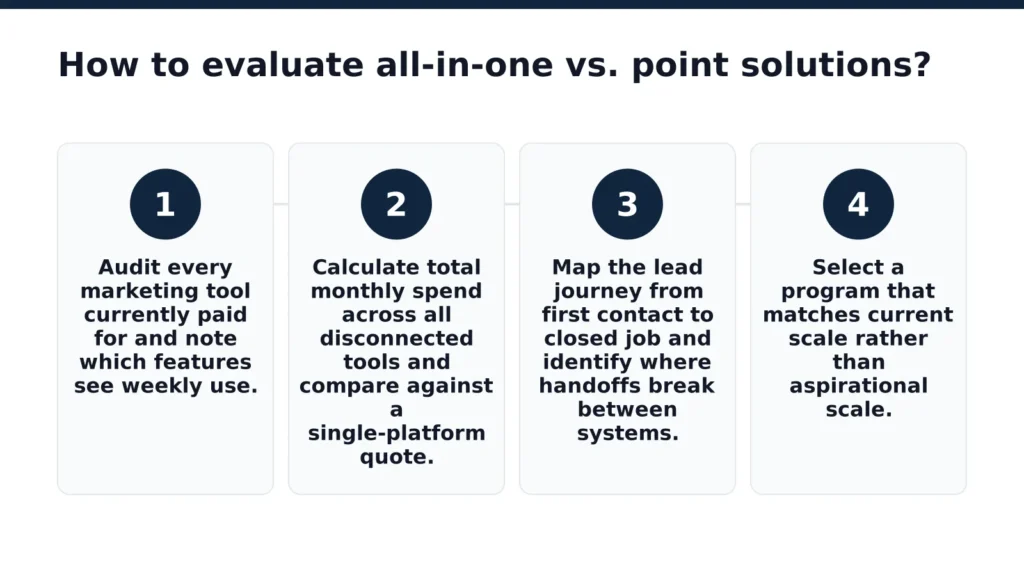
Follow these steps to make the evaluation:
Audit every marketing tool currently paid for and note which features see weekly use.
Calculate total monthly spend across all disconnected tools and compare against a single-platform quote.
Map the lead journey from first contact to closed job and identify where handoffs break between systems.
Select a program that matches current scale rather than aspirational scale.
What is a 5-step framework to choose the right tool?
Selecting marketing automation requires a structured evaluation of business needs. The right platform depends on business size, marketing goals, customer data needs, and automation requirements. Contractors who skip this framework risk purchasing disconnected tools that fail to close the gap between lead capture and signed contracts.
What factors determine the best fit for a contracting business?
Four criteria separate effective platforms from expensive misfires. Business size dictates whether a lightweight CRM or enterprise orchestration tool makes sense. Marketing goals clarify whether the priority is review collection, email sequences, or multi-channel campaigns. Customer data needs determine how deeply the platform must integrate with existing job management software. Automation requirements define the complexity of workflows the system must execute.
Step 1: Define the primary marketing objective. A contractor focused on reputation management needs different capabilities than one building complex bid follow-up sequences. Podium wins for reputation and review collection. ActiveCampaign is best for agencies managing segmented email automation, depending on the quality and freshness of customer fields.
Step 2: Assess current operational gaps. Identify where leads stall between initial contact and closed deals. JobNimbus wins for smaller contractors needing job tracking plus CRM in one. US Tech Automations wins for custom sequences across bid, follow-up, and referral channels.
Step 3: Map required integrations. List every existing system the automation tool must connect with. Disconnected reporting wastes the $400 to $1,200 per month mid-size general contractors typically spend on marketing technology.
Step 4: Evaluate scalability. A tool that fits a three-person crew fails under a twenty-truck operation. The platform must handle growing contact lists and increasingly complex campaign logic without requiring a full migration later.
Step 5: Verify reporting and attribution. The system must show which campaigns produce estimates and which estimates convert to revenue. Without this visibility, marketing spend becomes an expense rather than an investment.
How does a full-service approach simplify tool selection?
Contractors who outgrow single-purpose platforms benefit from a unified system. Lead Nurture Close Web Marketing provides Digital Marketing for Contractors through SEO, Google Maps optimization, social media management, Google Ads, and Facebook Ads. This integrated approach eliminates the need to stitch together multiple disconnected tools while generating the best leads in a contractor’s market.
How to turn automation into booked jobs consistently?
Automation converts leads into booked jobs when every handoff is tracked. Lead Nurture Close Web Marketing builds systems where follow-up responsibility and outcomes are recorded at each stage. Without that clarity, even the best leads slip through the cracks.
Contractors lose revenue when no one owns the follow-up. A contractor client needs to know who follows up and where the result is recorded. Agency automation must be chosen around that handoff before comparing how many campaign types a platform offers. The system matters more than the feature list.
What does a complete contractor marketing system include?
Digital marketing for contractors combines several integrated components. Each element feeds the next, creating a continuous lead-to-job pipeline.
SEO and local search optimization to capture high-intent traffic
Pay-per-click advertising targeting service-specific keywords
High-converting website design built for mobile and speed
Social media marketing that builds brand authority
Reputation management to generate and showcase reviews
Marketing automation that nurtures leads until they book
How does automation improve year-round booking consistency?
Lead Nurture Close Web Marketing’s system turns website traffic and ad clicks into booked jobs with transparent reporting and continuous optimization. The company helps establish a home service brand as the authority in its market so contractors stay busy year-round. Seasonal slowdowns shrink when automated nurture sequences keep past clients engaged and referral pipelines active.
FAQ
What happens to contractors who skip marketing automation?
They lose revenue to faster competitors. The process captures the lead, sends a personalized estimate confirmation, triggers follow-up texts, delivers a scheduling link, and requests a review once the job completes.
What programs does Lead Nurture Close Web Marketing offer for contractors?
Lead Nurture Close Web Marketing offers an Essentials Program for single-location home service businesses and an Enterprise Program for businesses managing three or more locations.
Conclusion
Selecting marketing automation without a structured evaluation leaves contractors with disconnected tools that fail to close the gap between lead capture and signed contracts. The five-step framework (defining the primary objective, assessing operational gaps, mapping integrations, evaluating scalability, and verifying reporting) provides the clarity needed to choose a platform matching current scale. Contractors who skip this process risk losing revenue to faster competitors. The next step is applying this framework to your own business before committing to any system. Call us today to put this framework to work for your business and start closing more jobs.