Distinct Home-Service Marketing Strategies to Put Your Business Ahead Locally
Standing out in local home services means combining precise local visibility, high-intent paid channels, trust-building content, and automation that turns inquiries into booked jobs. This guide explains what “unique marketing strategies” look like for plumbers, HVAC techs, garage door specialists, landscapers, and other contractors — and how those tactics generate more qualified local leads and higher close rates. You’ll get a clear look at local SEO for service-area businesses, how Google Local Service Ads and targeted PPC layer together, which content formats reliably convert homeowners, and how AI plus marketing automation shortens response time while improving lead quality. Many operators waste ad spend, chase low-quality leads, and deliver a fragmented customer experience; this article gives tactical, immediately actionable steps to close those gaps using omnichannel presence, conversion-focused landing pages, and measurement that ties marketing back to revenue. We map five core areas — Local SEO, Paid Advertising, Content Marketing, AI & Automation, and Measurement — and include practical checklists, EAV comparison tables, and execution lists you can apply now. Throughout, we use semantic strategies and entity-driven language that align with how search and AI systems understand service providers, helping your content and ads convert better than one-size-fits-all approaches.
If you want help scaling lead generation without losing local focus, Lead Nurture Close Web Marketing provides systems built for home services, including LeadNurtureClose 360®, the Home Services Omnipresence Marketing System, Organic Traffic System, Paid Traffic System, and Marketing Automation. To see how these solutions fit your garage door business, request a quote or schedule service. This short vendor note frames the practical tactics below and then returns to hands-on steps you can apply right away.
How Local SEO Drives Growth for Home Service Businesses
Local SEO boosts visibility by matching your service-area relevance to real searcher intent, which produces higher-quality calls and form fills from nearby homeowners. Optimize your Google Business Profile, build consistent local citations, and publish geo-targeted landing pages that answer neighborhood queries so you capture intent-driven searches and convert them into scheduled jobs. Search engines rank service providers using proximity, relevance, and trust signals — reviews and structured data matter — and tuning those signals reduces friction between discovery and booking. Below we dive into GBP best practices, citation strategy, and an EAV table that links actions to expected outcomes so you can prioritize quick wins and long-term authority.
Local SEO delivers three immediate tactical wins:
- Greater visibility for service-area searches, which increases inbound calls and form submissions.
- Stronger trust signals on map results — complete GBP listings and reviews lift click-to-call rates.
- Better alignment with local intent through geo-targeted pages that convert searchers into appointments.
Best Practices for Optimizing Your Google Business Profile
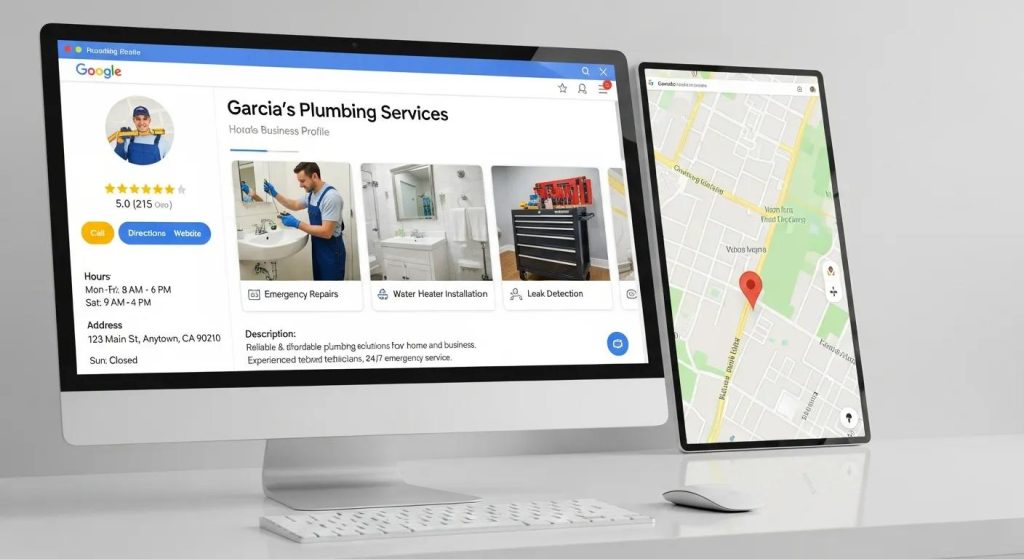
Your Google Business Profile (GBP) is the top free listing for home service companies because it puts your NAP, services, photos, and booking links in front of homeowners at search time. Make the profile complete and accurate: set correct service categories and service-area settings, list services with locally relevant keywords that match your primary pages, and add strong before/after photos and short videos to show workmanship. Publish regular GBP posts and FAQs to lift engagement metrics that correlate with local rankings. Solicit structured reviews and reply to questions within 24–48 hours to keep the listing active and credible. These GBP actions also support citation consistency and landing-page relevance, which we cover next.
How Local Citations and Geo-Targeted Landing Pages Increase Visibility
Consistent citations across niche directories and local platforms build legitimacy search engines use as a trust signal, while geo-targeted landing pages capture neighborhood-level intent because they speak directly to local concerns. Build landing pages from a repeatable template: service+ location headline, scoped services list, local proof (reviews, badges), schema markup for service area, and a clear conversion path like click-to-call or online booking. A/B test city vs. neighborhood targeting and measure GBP actions and landing-page conversions to see which customer segments deliver the best ROI. Strong citation work and targeted pages reduce dependence on broad PPC by funneling organic local demand into your scheduling flow.
Below is a concise comparison of core local SEO components and their expected impact.
The table below compares local SEO components, the optimization step, and the expected outcome to help prioritize actions.
| Local SEO Component | Optimization Step | Expected Outcome |
|---|---|---|
| Google Business Profile | Complete categories, services, photos, posts | More map visibility and click-to-call volume |
| Local Citations | Consistent NAP on niche directories | Improved local authority and ranking stability |
| Geo-targeted Landing Pages | Service + location content, schema, reviews | Higher conversion rate for neighborhood searches |
This EAV comparison shows that a complete GBP and targeted pages produce quick visibility gains, while citation consistency supports sustainable local authority.
Which Paid Advertising Techniques Drive Home-Service Leads?
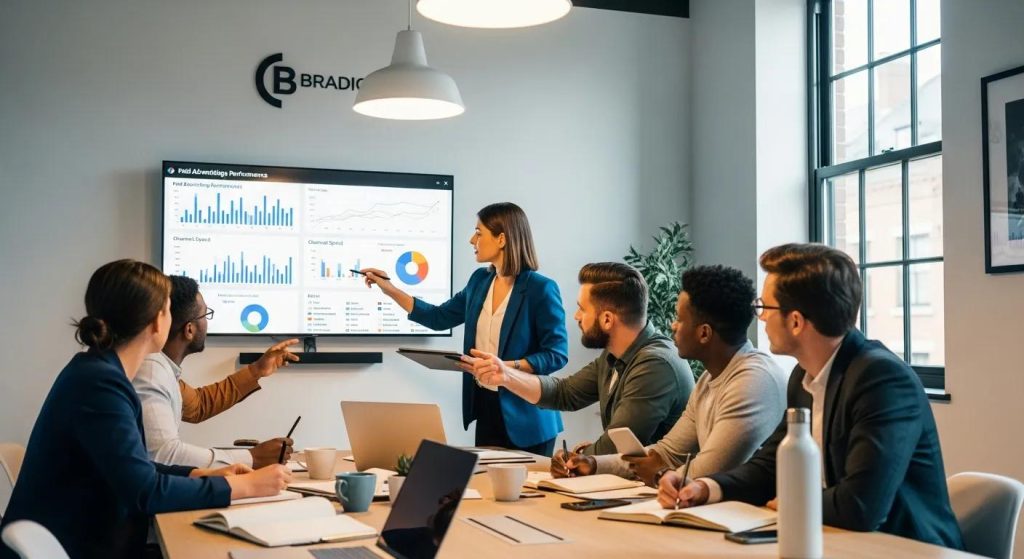
Paid advertising works best when channels align with intent and urgency and when you build layered funnels that capture, qualify, and convert across touchpoints. Google Local Service Ads target immediate intent and often generate higher call volume for emergency needs, while search PPC scales visibility for mid- and low-urgency keywords; social ads are effective for seasonal offers and retargeting. Combining LSAs, intent-focused PPC, and social retargeting creates funnel coverage that lowers cost per booked appointment because each channel complements the others by intent and timing. Below we contrast LSAs and PPC and outline retargeting tactics that boost conversion efficiency.
Key paid-ad tactics for contractors:
- Separate bids for emergency/high-intent keywords and scheduled-service keywords to control CPL.
- Use LSAs for instant trust signals and PPC to own broader keyword sets.
- Layer retargeting sequences by behavioral intent to recapture visitors who viewed quotes or service pages.
Why Google Local Service Ads Often Beat Traditional PPC
Google Local Service Ads (LSAs) tend to outperform traditional PPC for emergency and high-intent homeowner searches because LSAs display a trust badge, enable direct calls, and usually convert at higher rates per lead. LSAs use a pay-per-lead model instead of pay-per-click, which can cut wasted spend for urgent services, and they place vetted providers at the top of results where phone-based conversions are common. Traditional PPC still offers advantages — keyword control, ad extensions, and landing-page testing — so the best approach runs LSAs for immediate calls and PPC to fill the mid-funnel with educational and comparison queries. Track customer segments closely to see which channel produces booked jobs.
LSA setup and optimization checklist:
- Complete business verification and claim all relevant service categories.
- Monitor lead quality and dispute invalid leads promptly to protect ROI.
- Sync LSA leads with your scheduling system or CRM for rapid follow-up.
Comparison of paid channels and when to use each: digital marketing services
| Paid Channel | Characteristic | Best Use Case |
|---|---|---|
| Local Service Ads (LSAs) | Pay-per-lead, trust badge, call-first | Emergency repairs, high-intent calls |
| Search PPC | Keyword control, scalable reach | Scheduled installs, brand visibility |
| Social Retargeting | Visual proof, audience segmentation | Follow-up and seasonal promotions |
Effective Retargeting and Social Ad Strategies for Contractors
Retargeting should reflect the visitor’s last action and step up messaging as intent rises. For example, quote-page viewers should see testimonial videos and limited-time booking incentives, while casual blog readers receive helpful tips and awareness creatives. Segment audiences by behavior and recency — site visitors, service-page viewers, quote abandoners — and set frequency caps and windows that match service purchase cycles like HVAC maintenance or garage door replacement. Use dynamic creative with before/after visuals and short video testimonials to increase engagement, and make sure landing-page CTAs align with ad messages for seamless conversion. When paired with on-site conversion optimization, these retargeting flows lift lead quality and reduce CPL.
Suggested retargeting audiences and creatives:
- Site visitors (7–30 days): educational videos and local case studies.
- Quote-page abandoners (1–14 days): limited-time discounts and direct booking CTAs.
- Customers (post-service): review requests and referral offers.
How Content Marketing Builds Authority and Trust for Home Services
Content marketing builds authority by answering homeowner questions, showcasing expertise with case studies and video, and producing assets that rank for long-tail, high-conversion queries. Detailed service pages with FAQs, troubleshooting videos, and case studies with measurable outcomes reduce friction in the buying journey and strengthen trust signals in search and social channels. The goal is to turn content into lead-generating assets — local blog posts that answer neighborhood queries, how-to videos that show workmanship, and downloadable guides that act as lead magnets. Below we rank the content types that convert best and explain how review-driven tactics multiply the value of those assets across channels.
High-converting content formats:
- Video case studies showing before/after results and the process.
- In-depth service pages and localized FAQs that capture PAA queries.
- Troubleshooting guides and step-by-step content that capture long-tail searchers.
Which Content Types Convert Best for Home Service Businesses?
Video and before/after galleries convert quickly because they show visual proof of skill and outcome — especially persuasive for garage door repairs or pool builds. Detailed service pages with structured FAQs reduce pre-sale friction by answering common objections and laying out next steps, while downloadable checklists and maintenance guides work as lead magnets that move prospects into nurture flows. Case studies that quantify results — time to fix, cost savings, or efficiency gains — deliver credibility that turns leads into booked jobs. Distribute this content through local search, social ads, and GBP posts to reinforce your omnipresence and speed conversions.
If you run a garage door business and want help turning content into booked jobs, request a quote or schedule service.
How Reviews and Referrals Increase Customer Trust
Online reviews and referral programs are powerful trust multipliers: satisfied customers become social proof that influences both rankings and homeowner decisions. Set up an automated review workflow triggered post-service, provide simple templates for responses to positive and negative feedback, and surface top reviews on landing pages and your GBP to boost credibility. Referral programs that reward customers for introductions create a low-cost stream of warm leads and increase lifetime value through repeat business. Paired with content that highlights case studies and testimonials, review automation spreads trust across every customer touchpoint.
The five-step review and referral process:
- Trigger automated review requests within 24–72 hours after service.
- Send one-click review links and clear guidance for customers.
- Respond publicly to reviews within 48 hours in a professional tone.
- Feature top reviews on service pages and landing pages for local relevance.
- Run a referral program with simple incentives and easy tracking.
Innovative Local Marketing Strategies for Home Service Businesses
AI and marketing automation speed lead response, improve qualification, and keep follow-up consistent — all of which raise the percentage of leads that become booked appointments. Chatbots and AI lead scoring capture inquiries 24/7 and route high-intent contacts directly to dispatch or a scheduler, while automation sequences nurture lower-intent prospects with personalized messages that move them down the funnel. Integrating these systems with a CRM like LeadNurtureClose 360® enables closed-loop measurement so you can attribute revenue to channels and workflows. The sections below outline concrete AI chat benefits and the most effective customer segments for appointment funnels.
AI-driven automation delivers three concrete benefits: website design development
- Faster response times that reduce lead drop-off and increase contact rates.
- Improved lead qualification to prioritize dispatch and scheduling.
- Scalable, personalized follow-up that increases bookings without extra headcount.
Benefits of AI-Driven Lead Nurturing and Chatbots
AI chatbots and conversational lead forms shorten time-to-contact by collecting homeowner needs naturally and qualifying by service, urgency, and budget before handing off to scheduling. Faster responses lift conversions because many homeowners decide within minutes or hours of searching, and chatbots capture leads 24/7 when live staff aren’t available. AI lead scoring flags high-value prospects for immediate human follow-up and reduces wasted field time by filtering low-intent queries. Paired with structured handoffs to technicians or schedulers, chat and scoring close more booked jobs and improve customer segments.
Practical AI outcomes include fewer no-shows via automated confirmations, better first-call resolution because technicians receive pre-captured issue details, and measurable conversion gains when integrated with a CRM.
How Marketing Automation Workflows Improve the Customer Experience
Marketing automation — welcome messages, appointment reminders, review requests, and nurture sequences — standardizes the customer experience while lowering operational friction and improving retention. Behavior-triggered messages (appointment booked, quote requested, visit completed) keep customers informed and reduce no-shows, while personalized nurture flows re-engage prospects who didn’t book initially with seasonal offers or maintenance tips. Automations also streamline internal ops: SMS/email confirmations, technician dispatch alerts, and post-service follow-ups that request reviews and referrals. Together, these workflows create a predictable, scalable customer journey across service areas and seasons.
Sample automation sequence for a booked appointment:
- Immediate confirmation message with technician name and contact.
- 24-hour reminder with prep tips and an ETA window.
- Post-service follow-up requesting feedback and a review.
- Maintenance nurture sequence 6–9 months after service.
Which Metrics Show Home Service Marketing Success?
Tracking the right metrics ties marketing activity to booked appointments and revenue so you can invest where it pays. Monitor both volume metrics (traffic, GBP actions, ad impressions) and quality metrics (lead-to-book conversion rate, cost per lead, close rate). Attribution needs call tracking, CRM, and ad-platform integration so you can trace a lead from first touch to paid job. Below we list key KPIs, an EAV table linking metrics to outcomes, and guidance on benchmark setting for small and mid-sized service businesses.
Top KPIs to monitor: lead volume by source, conversion rate (lead→booked), cost per lead, close rate, and LSA/PPC ROI. These metrics steer budgeting and optimization cadence. Use the list below as a practical starting point.
- Lead volume and source attribution to measure channel impact.
- Conversion rate from lead to booked appointment to judge lead quality.
- Cost per lead and ROI to ensure acquisition is profitable.
Key Performance Indicators That Matter Most
Lead volume shows whether visibility tactics are working, while lead-quality metrics — conversion rate and close rate — reveal whether those leads are worth pursuing. CPL and lifetime value (LTV) inform sustainable bidding and acquisition budgets, and GBP actions (calls, direction requests, website visits) act as early indicators of local engagement. Track time-to-contact and response times because faster follow-up correlates with higher booking rates. Use your CRM to combine these metrics into dashboards that show channel profitability and technician utilization.
Mapping KPIs to business outcomes:
| Metric | Description | How it Correlates to Business Outcome |
|---|---|---|
| Lead Volume by Source | Number of contacts per channel | Indicates which channels generate demand |
| Conversion Rate (Lead→Booked) | Percent of leads that schedule | Measures lead quality and sales effectiveness |
| Cost Per Lead (CPL) | Marketing spend divided by leads | Guides budget and bidding decisions |
How Continuous Optimization Keeps You Ahead
Continuous optimization combines quarterly audits, A/B testing, and competitor monitoring to adapt to market shifts and search algorithm changes. Run a quarterly checklist that includes content refreshes, GBP activity reviews, ad creative tests, landing-page A/Bs, and automation flow checks to capture incremental gains. Use CRM and call-tracking data to test hypotheses — for example, whether a different booking CTA improves conversions — and iterate quickly on statistically significant lifts. Monitor local SERP features, GBP behavior, and competitor moves so you can update messaging and preserve your local advantage.
Quarterly optimization checklist:
- Content audit and refresh of top-ranking service pages.
- Ad creative and landing-page A/B tests for top-converting keywords.
- GBP post cadence and review response audit.
- Automation workflow review and lead-scoring calibration.
When you’re ready to turn optimized systems into more booked jobs, Lead Nurture Close Web Marketing can integrate the Home Services Omnipresence Marketing System with LeadNurtureClose 360® plus the Organic Traffic System, Paid Traffic System, and Marketing Automation tools to close the loop — request a quote or schedule service.
Frequently Asked Questions
What role does social media play in home service marketing?
Social media helps you engage your local audience, show real work, and build awareness. Platforms like Facebook and Instagram are perfect for before/after photos, short testimonials, and how-to posts that resonate with homeowners. Paid social lets you target geography and demographics to drive traffic to your booking page or site. Regular interaction builds trust and repeat business, and social proof shared on these channels supports both reputation and lead generation.
How can I effectively use video marketing for my home service business?
Video gives visual proof of your skills and results. Produce short how-to clips, customer testimonials, and project highlights that demonstrate workmanship and process. Post videos on your site, social channels, and YouTube to extend reach. Consider live Q&A or quick walkthroughs to answer common homeowner questions in real time. Video improves engagement, builds trust, and helps prospects decide faster.
What are the best ways to encourage customer referrals?
Set up a simple referral program that rewards customers for successful introductions — discounts, gift cards, or service credits work well. Make referrals easy with shareable links or referral cards and follow up after a job while satisfaction is high. Highlight positive reviews and testimonials on your site and social to encourage word-of-mouth. Clear incentives and easy tracking keep the program low-cost and effective.
How can I measure the effectiveness of my marketing strategies?
Measure success by tracking KPIs like lead volume, conversion rates, and acquisition cost. Use Google Analytics for site behavior, add call tracking for phone leads, and tie everything into your CRM to see which channels produce booked jobs. Set benchmarks and review metrics regularly so you can optimize leads and scale the tactics that work.
What are some common mistakes to avoid in home service marketing?
Common mistakes include ignoring local SEO, leaving your Google Business Profile incomplete, and underutilizing customer reviews. Mobile optimization is critical — many homeowners search from phones — so make sure calls-to-action and booking flows work on mobile. Keep branding consistent across platforms and always track performance so you can stop wasting budget on underperforming tactics.
How can I improve my website's conversion rate?
Improve conversions by making your site fast and easy to navigate, using clear CTAs for booking or quotes, and adding trust signals like testimonials, case studies, and certifications. A/B test landing pages to find the messaging and layout that performs best. Regularly update content and optimize for local search to attract more qualified visitors.
Conclusion
Unique, locally focused marketing is essential for home service businesses that want consistent, qualified leads. Combine local SEO, targeted paid advertising, high-value content, and automation to improve visibility, lead quality, and booking rates. Apply the checklists and tactics in this guide to elevate your local presence and grow revenue sustainably. For tailored help that maps to your business, request a quote or schedule service today.