Turn Local Searches into More Home Service Leads
Making your home service website a reliable lead engine means aligning search visibility, user experience, content, and technical health so visitors call, book, or request a quote. This guide gives practical, high-impact tactics that attract qualified local traffic and improve conversion for contractors, plumbers, HVAC teams, garage door companies, landscapers, and pool builders. You’ll get clear steps for targeted local SEO and a fully optimized Google Business Profile that turn searches into phone calls, learn why conversion-focused design and mobile-first patterns capture on-the-go customers, and see which content and paid strategies extend your organic reach. We also cover technical essentials—Core Web Vitals, structured data, and site security—and conversion UX improvements like CTAs, forms, and live chat. Each section pairs strategy with action items, checklists, and comparison tables so you can prioritize work and measure steady lead growth.
Essential Local SEO Tactics for Home Service Businesses

Local SEO for home services is about showing up when nearby customers search for the services you offer. The method is straightforward: tune location signals (Google Business Profile, citations, service-area pages), target intent-driven local keywords, and build local backlinks and reviews to increase relevance and trust. The result: higher rankings for “near me” searches, more calls, and better-qualified leads. Start with a Google Business Profile (GBP) and citations audit, map keywords to dedicated service pages, and put a repeatable review-generation process in place. These core steps create a steady stream of organic leads that are ready to convert.
Local SEO checklist for quick wins:
- Claim and verify your Google Business Profile and keep NAP consistent across listings.
- Publish service and service-area pages that match local-intent keywords.
- Ask for and respond to reviews, and earn local backlinks from suppliers and partners.
These three priorities raise local relevance quickly. The next section shows how to optimize your GBP to capture search visibility right away.
How to Optimize Your Google Business Profile for Maximum Local Visibility
Optimizing your Google Business Profile starts with completing every field and choosing the most accurate categories for your services. Google rewards clarity: profiles with full, up-to-date information perform better for relevant queries. Add service listings, a concise business description, service areas, and high-quality photos of recent work. Encourage reviews and respond quickly—use replies to reinforce key service terms naturally. Publish Google Posts for promotions or seasonal services to show activity. A well-maintained GBP drives more calls and directions from mobile searchers and feeds map-pack rankings, so review management should be part of your ongoing local SEO routine.
GBP optimization steps to follow:
- Claim, verify, and maintain consistent NAP across platforms.
- Add service listings, a clear business description, hours, and strong images.
- Set up a repeatable review solicitation and response process.
Completing these steps sets your site up for keyword-driven service pages that convert visitors into booked jobs.
Table overview: A quick comparison of local citation and review tactics to help you prioritize immediate actions and expected impact.
| Local Asset | Best Practice Action | Expected Impact / Timeframe |
|---|---|---|
| Google Business Profile | Complete every field, add services and photos, publish posts weekly | Higher map-pack visibility within 2–8 weeks |
| Local Citations | Audit major directories, fix NAP inconsistencies, focus on niche listings | Improved local relevance in 4–12 weeks |
| Reviews | Request reviews consistently, reply within 48 hours, reinforce keywords naturally | More trust and conversions within 2–6 weeks |
| Local Backlinks | Outreach to partners, sponsorships, and local press mentions | Authority gains and ranking support in 8–16 weeks |
This comparison shows which local signals give quick visibility and which take longer, so you can sequence work for faster lead gains.
Best Practices for Local Keyword Research and Citation Building
Local keyword research identifies queries that show buying intent—service + location or modifiers like “repair,” “install,” and “emergency”—and maps them to the right page intent. Start with seed terms (your service names) plus geo modifiers to build a prioritized keyword list, then assign primary and secondary keywords to service pages, FAQ blocks, and service-area pages. For citations, audit existing mentions, correct inconsistencies, and add entries to high-authority and niche directories that matter for your trade. Targeted local backlinks from suppliers, associations, and community sites increase relevance and support rankings for competitive queries. Prioritizing intent-driven keywords and clean citation hygiene turns visibility into a predictable lead stream.
Local keyword and citation best practices:
- Research combinations of service + city + modifier and sort by intent and volume.
- Map primary keywords to single-purpose service pages and use secondary terms in FAQs.
- Audit citations quarterly and pursue niche local directories for backlink opportunities.
Effective keyword mapping and citation maintenance reduce wasted ad spend and improve organic lead quality over time.
Many businesses speed results by pairing organic work with conversion-focused design and targeted paid campaigns.
How Website Design Boosts Lead Generation for Home Service Providers
Good website design increases lead volume by removing friction and guiding visitors toward contact actions with clear visual hierarchy, concise copy, and trust signals. Think conversion architecture: when your value proposition, reviews, project photos, and contact options are obvious, visitors move from researching to requesting a quote faster. High-converting local service businesses use above-the-fold CTAs, prominent phone numbers for mobile users, and concise service pages that answer intent-specific questions. Prioritize elements that communicate reliability—case studies, certifications, and before/after galleries—so prospects quickly understand your capability and feel confident to convert. A design-first approach turns traffic into measurable leads with higher close rates.
Key web design features that increase conversions for local marketing:
- Clear value proposition and contact options near the top of the page.
- Trust elements—reviews, local project photos, and certifications—close to CTAs.
- Focused service pages with benefit-driven copy and obvious next steps.
These features prepare service pages to convert. The table below compares landing-page elements and their impact on conversion.
Table overview: Landing page elements to prioritize for conversion-focused design.
| Element | Best Practice | Conversion Uplift Example |
|---|---|---|
| Above-the-fold CTA | Benefit-led button plus click-to-call on mobile | +15–30% more clicks to the lead form |
| Short lead form | 3–5 fields, optional scheduling | +20% form completions vs long forms |
| Social proof | Reviews and project photos near CTAs | +10–25% trust-driven conversions |
| Live chat | Immediate qualification and booking | +8–18% higher lead capture rate |
This table highlights high-impact elements to implement first and how small design tweaks generate measurable uplift.
User Experience Features That Boost Conversions on Contractor Websites
UX improvements that raise conversions reduce cognitive load and make contacting you the obvious next step. Key tactics include clear navigation that highlights top services, benefit-first headlines, and microcopy that sets expectations for response time and next steps. Keep forms minimal and use progressive disclosure for complex requests; place trust signals next to forms to ease hesitation. Structure content to guide users from problem to solution with a clear CTA on every service page. Better UX lowers bounce rates and increases qualified lead submissions—testing CTA wording and form length often yields quick wins.
UX features to implement and test:
- Simplified navigation focused on core services and service areas.
- Benefit-driven microcopy on CTAs and form labels to reduce friction.
- Visible trust elements (reviews, local case studies) near conversion paths.
These UX improvements make the journey from discovery to booking intuitive and measurable. Mobile-first patterns amplify those gains, as described next.
Why Mobile-First Design Matters for Home Service Websites
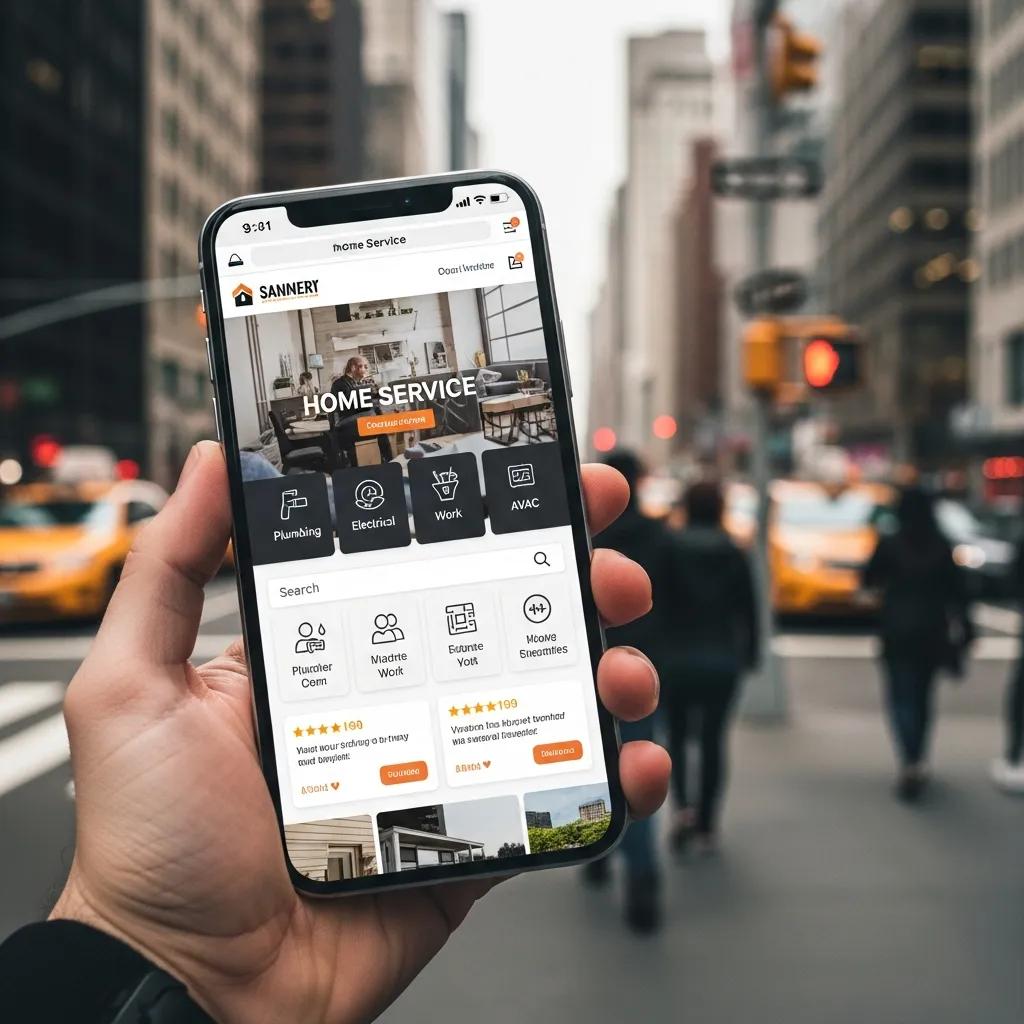
Mobile-first design is critical because most local service searches start on phones—often with the intent to call or book immediately. The focus is accessibility: larger tap targets, reduced content density, and click-to-call buttons cut friction and speed contact. Make phone numbers, request-a-quote buttons, and scheduling widgets reachable without scrolling; use sticky CTAs for constant access. Compress images, use responsive type scales, and write concise mobile-specific copy to keep load times fast and messaging clear. Mobile-first improvements directly increase calls and form submissions from on-the-go searchers.
Mobile-first checklist:
- Make click-to-call and request buttons prominent and thumb-reachable.
- Compress images, enable lazy-loading, and limit third-party scripts.
- Use concise messaging and persistent CTAs for immediate action.
Mobile-first UX converts more local searches into booked jobs, and when combined with local SEO it’s often the fastest path to better-quality leads.
Content Marketing Strategies That Drive Leads for Home Service Companies
Content marketing builds trust and captures searchers at every stage—awareness, evaluation, and decision—by answering questions and showing results. The mechanism is relevance: service pages and targeted blog posts that mirror customer queries earn clicks and create conversion opportunities through embedded CTAs. Use case studies, how-to guides, and localized content to demonstrate expertise and local experience, and structure pages so intent naturally leads to a next step. Visual content—before/after galleries and short walkthrough videos—lowers perceived risk and increases quote requests. Consistent content that addresses local problems positions your site as the go-to provider and grows inbound leads over time.
Content types that convert:
- Service pages optimized for transactional intent with pricing cues and clear process steps.
- Localized blog posts and FAQ content that answer common homeowner questions.
- Visual case studies and short videos that show results and the process.
These formats boost organic visibility and create multiple conversion touchpoints; the next sections include templates and schema guidance.
How to Create Service Pages That Convert Visitors into Customers
Service pages convert when they start with the customer’s problem, explain the solution and process, and finish with a clear call-to-action. Structure pages with a headline that matches intent, a benefits section, a simple step-by-step process, pricing cues or ranges, and multiple conversion points (call, form, chat). Add local proof—nearby projects and testimonials—and include FAQs to answer objections upfront. SEO-first copy puts the primary local keyword in headings and alt text while keeping the page customer-focused. This blend of clarity and strategy turns informational clicks into booked jobs.
Service page template to follow:
- Headline that includes the service and service area.
- Three benefit bullets and a short 3-step process.
- Pricing cue, trust elements, and repeated CTA.
Using this template reduces friction and improves conversion rates for visitors ready to request a quote.
The Role of FAQs and Visual Content in Engaging Customers
FAQs and visual content remove friction by answering common objections and showing real results to build trust. FAQ sections capture “People Also Ask” queries and—when marked up with FAQPage schema—can earn rich results. Visuals like before/after photos, short walkthrough videos, and annotated images demonstrate craftsmanship and clarify scope. Use descriptive captions and entity-rich alt text to reinforce local seo keywords and project context. Together, FAQs and visuals move hesitant prospects into confident leads by addressing both practical and emotional concerns.
FAQ and visual best practices:
- Use FAQ schema for common service questions to increase SERP presence.
- Include short video clips (30–90 seconds) that show typical jobs and outcomes.
- Add local captions and descriptive alt text to strengthen entity relevance.
These tactics keep visitors engaged and speed the shift from research to booking.
Once your content attracts and educates, advanced marketing automation system can scale and convert at volume.
Advanced Lead Generation Tactics That Complement Organic Work
Advanced tactics—Local Services Ads (LSAs), PPC, retargeting, and email automation—scale demand and capture high-intent prospects that organic channels take longer to reach. The idea is amplification: paid channels give immediate visibility for competitive queries, while automation nurtures and qualifies leads after capture. Link paid and organic with shared tracking, UTM tags, and a central CRM to monitor cost-per-lead and lead quality. Retarget visitors who viewed service pages and use email sequences for estimate follow-ups. When aligned with organic foundations, paid tactics build a predictable funnel for steady lead volume and higher close rates.
Paid and automation playbook:
- Run LSAs for instant local presence and trust; use PPC to support promotions.
- Retarget visitors with creative tailored to the pages they viewed.
- Route leads into a CRM for scoring, automation, and dispatch.
This integrated setup balances immediate demand capture with sustainable organic growth and measurable results.
How to Use PPC and Local Services Ads to Grow Leads
LSAs deliver instant trust in local queries, while PPC gives precise control for promotions, seasonality, and costly keywords. LSAs offer a profile-style presence with direct lead routing; PPC lets you test ad copy and landing pages. Build campaigns by service and service-area, use call-only and lead-form ads for mobile, and set budgets based on historical conversion data. Always feed conversions into your CRM and optimize toward cost-per-lead and lead quality rather than clicks to keep ROI sustainable.
PPC and LSA setup checklist:
- Enable LSAs for core services where available.
- Create service-area PPC campaigns with call-only and lead-form options.
- Feed leads into your CRM and optimize by CPL and close-rate performance.
Following this checklist helps paid spend generate qualified leads that integrate with your organic channels for a consistent pipeline.
Social Media and Email Strategies That Increase Leads
Social and email work together to raise awareness and nurture prospects with timely follow-ups. Social platforms amplify before/after content and testimonials to local audiences, while email automation moves leads toward booking with sequenced confirmations, reminders, and upsell messages. Use short social videos to showcase quick wins and retarget audiences with offers tied to service pages they visited. Email sequences should prioritize immediate follow-up, include one-click scheduling, and escalate high-intent replies to phone outreach. When tied to website tracking and CRM workflows, these channels lower CPL and boost lifetime value.
Tactical social and email sequence examples:
- Share local project highlights and short testimonial clips targeted to nearby zip codes.
- Build an email nurture: immediate confirmation, reminder, and estimate follow-up over 7–14 days.
- Use automation to route high-intent responses to dispatch or sales for fast contact.
Paired with organic optimization, social and email create conversion loops that reinforce lead capture and booking.
Improve Website Performance and Technical SEO for Better Lead Capture
Technical SEO and site performance raise rankings and on-site conversion by improving speed, mobile UX, and trust signals. The mechanism is user experience: faster, secure sites with structured data rank better and keep visitors engaged long enough to convert. Focus on Core Web Vitals, HTTPS, image optimization, caching, and server response times. Add structured data for LocalBusiness, Service, and FAQ to enable rich results and lift click-through rates. These technical investments reduce bounce on high-intent pages and make all your marketing channels more efficient.
Performance optimizations to prioritize:
- Improve Core Web Vitals (LCP, INP, CLS) by optimizing images and resources.
- Enforce HTTPS and use fast hosting with caching and a CDN where appropriate.
- Add structured data for LocalBusiness, Service, and FAQ to enhance SERP features.
Table overview: Core Web Vitals benchmarks and practical fixes to prioritize.
| Performance Metric | Recommended Benchmark | Action to Improve |
|---|---|---|
| Largest Contentful Paint (LCP) | < 2.5s | Optimize images, preconnect critical resources, tune the server |
| Interaction to Next Paint (INP) | < 200ms | Reduce JavaScript and defer non-critical scripts |
| Cumulative Layout Shift (CLS) | < 0.1 | Reserve image dimensions and avoid late-loading elements |
| Time to First Byte (TTFB) | < 200ms | Use fast hosting, caching, and a CDN |
This comparison makes clear which metrics to watch and practical steps to improve both UX and search performance.
Why Mobile Responsiveness and Site Speed Matter
Mobile responsiveness and site speed affect rankings and user behavior for local searchers who expect instant answers and one-tap contact. Faster pages lower bounce rates and increase conversions by keeping users in the contact flow, while responsive layouts make click-to-call and scheduling elements accessible. Monitor Core Web Vitals and set performance SLAs for service pages, fixing bottlenecks like large images, unminified scripts, and render-blocking CSS. Prioritize a CDN and image compression to improve LCP and mobile usability quickly—this translates directly into more leads from mobile visitors.
Prioritized fixes for mobile performance:
- Compress and serve responsive images in modern formats.
- Defer or asynchronously load non-critical JavaScript.
- Implement caching and a CDN to reduce TTFB for regional visitors.
Fixing these areas raises mobile conversions and prevents loss of high-intent traffic.
How to Implement Structured Data and Secure Your Site for Trust
Structured data helps search engines understand your services and can surface rich results like service listings, FAQs, and local business details—boosting click-through rates. Add LocalBusiness and Service schema to contact and service pages with consistent NAP and serviceType entries, and use FAQ schema on Q&A blocks to increase SERP real estate. Secure the site with HTTPS, show visible trust indicators where appropriate, and run regular security scans to catch vulnerabilities. Together, schema and security signals improve both visibility and credibility, making visitors more likely to book appointments.
Implementation checklist for schema and security:
- Add LocalBusiness and Service schema with NAP and serviceType fields on core pages.
- Mark up FAQs with FAQPage schema where relevant.
- Ensure full-site HTTPS and run periodic security scans.
These steps boost discoverability and trust, increasing the likelihood visitors reach out.
User Experience Enhancements That Increase Conversions
UX enhancements that increase conversions reduce contact friction and ensure every conversion path triggers follow-up automation. The mechanism is clarity and speed: clear CTAs, short forms, live chat, and immediate confirmation pages make it easy for visitors to act and know what happens next. Progressive profiling collects required info without overwhelming prospects, and multiple contact options (phone, chat, form) meet different preferences. Post-conversion flows—confirmation pages and automated emails—set expectations and keep leads engaged until the job is scheduled.
Key conversion-focused UX recommendations:
- Use benefit-led CTA copy and high-contrast visuals to draw attention.
- Limit form fields and use multi-step forms for complex requests.
- Provide immediate confirmations and next-step communications via automation.
Applying these recommendations reduces abandonment and raises booking rates. The practical sections below explain how.
Designing Clear Calls-to-Action and Effective Lead Capture Forms
CTAs convert when they promise a clear benefit and a next step—examples include “Get a Free Quote” or “Schedule a Same-Day Estimate.” Place CTAs above the fold and next to service descriptions; use contrasting colors and tight microcopy to communicate urgency or value. Collect essentials only (name, phone, service, zip) to maximize completion and use multi-step flows for detailed estimates. Display trust signals near forms and offer alternative contact methods to capture users who prefer phone or chat. A/B test CTA text and form length to find the best-performing combinations over time.
Form and CTA best practices:
- Benefit-led CTA text with clear visual emphasis.
- Keep fields to essentials and offer optional fields for extra details.
- Display trust elements near forms and provide alternative contact options.
These tactics boost completion and lead quality; live chat further shortens response time as described next.
Benefits of Live Chat Integration for Lead Generation
Live chat increases lead capture by cutting wait times and qualifying prospects in real time, often turning hesitant visitors into booked appointments. Chat captures intent signals from page behavior, answers questions immediately, and routes high-intent leads to agents or schedulers. Use simple qualification scripts and fallbacks like email capture for after-hours traffic. Integrate chat with your CRM so conversations become actionable leads and feed follow-up automation. Properly configured, live chat raises conversion rates and speeds up the sales cycle.
Live chat implementation tips:
- Use a hybrid setup: bot for initial qualification, handoff to a human for booking.
- Capture contact details early and offer to schedule directly in chat.
- Push chat transcripts into your CRM for follow-up and quality tracking.
Combined with optimized forms and fast response workflows, live chat reliably increases lead volume and shortens time-to-booking.
If your team is ready to implement these combined strategies, consider pairing organic and design work with systems that streamline traffic, conversion, and lead management. Lead Nurture Close Web Marketing offers tailored solutions—like a Home Service Website System and an Organic Traffic System—to scale local SEO and conversion-focused design, while their Paid Traffic System and Marketing Automation System add paid amplification and automated follow-up. For centralized lead handling, LeadNurtureClose 360® CRM routes and nurtures leads to speed bookings.
Ready to Transform Your Lead Generation?
Partner with Lead Nurture Close Web Marketing to implement these proven strategies and turn your website into a powerful lead engine. Discover the right mix of site optimization, local SEO, paid amplification, and automation for your home service business.
Frequently Asked Questions
1. What are the key components of a successful lead generation strategy for home service businesses?
A successful lead generation plan combines local SEO, an optimized website, and targeted content marketing. Local SEO gets you found in searches, a user-friendly site converts visitors, and content—service pages, guides, and case studies—builds trust across the buyer’s journey. Together they drive more qualified leads.
2. How can I improve my website's user experience to increase conversions?
Improve UX by simplifying navigation, speeding up load times, and using clear, benefit-led CTAs. Use concise headlines, place trust signals near conversion points, and run regular A/B tests. Data-driven tweaks to layout, copy, and forms usually deliver noticeable conversion gains.
3. What types of content should I create to attract more leads?
Focus on service-specific pages, localized blog posts, and how-to guides that answer common homeowner questions. Add visual proof—before/after photos and short videos—to reduce perceived risk. FAQs help capture search queries and can earn rich snippets when marked up with schema.
4. How can I leverage email marketing to nurture leads?
Email nurtures leads with timely follow-ups: an immediate confirmation, reminders, and estimate follow-ups over 7–14 days. Segment lists for relevance and include one-click scheduling. Automated sequences keep prospects engaged and move them toward booking.
5. What are the benefits of using live chat on my website?
Live chat gives immediate answers, qualifies leads, and speeds booking when combined with a human handoff. Integrate chat with your CRM to capture details and automate follow-up—this raises conversion rates by reducing friction and response time.
6. How important is mobile optimization for lead generation?
Mobile optimization is essential—most local searches happen on phones and often result in calls. Ensure responsive layouts, fast load times, and thumb-reachable CTAs. Good mobile UX directly increases calls and form submissions.
7. What metrics should I track to evaluate my lead generation efforts?
Track conversion rate, cost per lead (CPL), and return on investment (ROI). Use Google Analytics and CRM data to monitor traffic sources, user paths, and goal completions. Regular reviews help you identify the best channels and optimize spend.
1. How can I measure the effectiveness of my lead generation strategies?
Measure performance with KPIs like conversion rate, cost per lead (CPL), and ROI. Use Google Analytics to track traffic sources, user journeys, and goal completions, and add tracking for forms and calls to attribute leads accurately. Review results regularly and shift budgets toward channels that produce the best leads.
2. What role does content marketing play in lead generation for home service businesses?
Content marketing builds authority and answers prospects’ questions at every stage. Informative posts, how-to guides, and service pages attract organic traffic and position your business as a trusted local provider—turning visitors into leads over time.
3. How often should I update my Google Business Profile?
Keep your Google Business Profile current—check and refresh it at least monthly, or when you add services, change hours, or run promotions. Respond to reviews quickly and post updates to show activity; regular maintenance helps local rankings.
4. What are the benefits of using structured data on my website?
Structured data helps search engines understand your content and can produce rich snippets that improve click-through rates. For home services, schema for services, reviews, and FAQs makes listings more informative and can boost conversions.
5. How can I effectively use social media to generate leads?
Use social to showcase local projects, before-and-after photos, and short testimonial videos. Run targeted ads by zip code, encourage interaction, and drive users to optimized landing pages with clear booking paths. Quick responses to inquiries improve conversion.
6. What are some common mistakes to avoid in lead generation?
Avoid not optimizing for mobile, failing to track performance, and missing clear CTAs. Don’t rely on a single channel—diversify across organic, paid, and social. Finally, ensure prompt follow-up; slow responses lose leads.
7. How can I improve my website's loading speed for better lead capture?
Improve load times by optimizing images and using modern formats, enabling browser caching, and deploying a CDN. Remove heavy scripts and choose reliable hosting. Regularly test with tools like Google PageSpeed Insights and fix recommendations to keep the site fast.
Boost Lead Generation Through Strategic Home Service Content
Optimizing your home service website for lead generation boosts visibility and conversion when local SEO, user-friendly design, and helpful content work together. Start by fixing foundational items like your Google Business Profile, service pages, mobile experience, and site performance. Then, layer in paid amplification and marketing automation to scale your efforts. When implemented correctly, these integrated strategies transform your online presence into a reliable, predictable source of qualified leads and booked jobs.